







9 ways to reduce customer acquisition costs

On this page
Every customer is precious because customer acquisition costs (CAC) are real cash out the door. CAC costs are always on the rise, becoming less predictable by the day amid fluctuating ad rates and attribution noise. In this constantly shifting environment, keeping your CAC costs down is essential.
Most teams try to reduce CAC by tuning the top of the funnel, such as landing pages and conversion rates. While these strategies are valuable, you could be neglecting the lowest-hanging fruit: cart abandonment. And in many cases, the final barrier to conversion is cart abandonment caused by payment failures.
8% of US online shoppers have abandoned an order because their credit card was declined. This statistic demonstrates that, for a meaningful slice of would-be buyers, the drop-off isn’t intent; it’s a decline at the point of purchase.
What is customer acquisition cost in e-commerce?
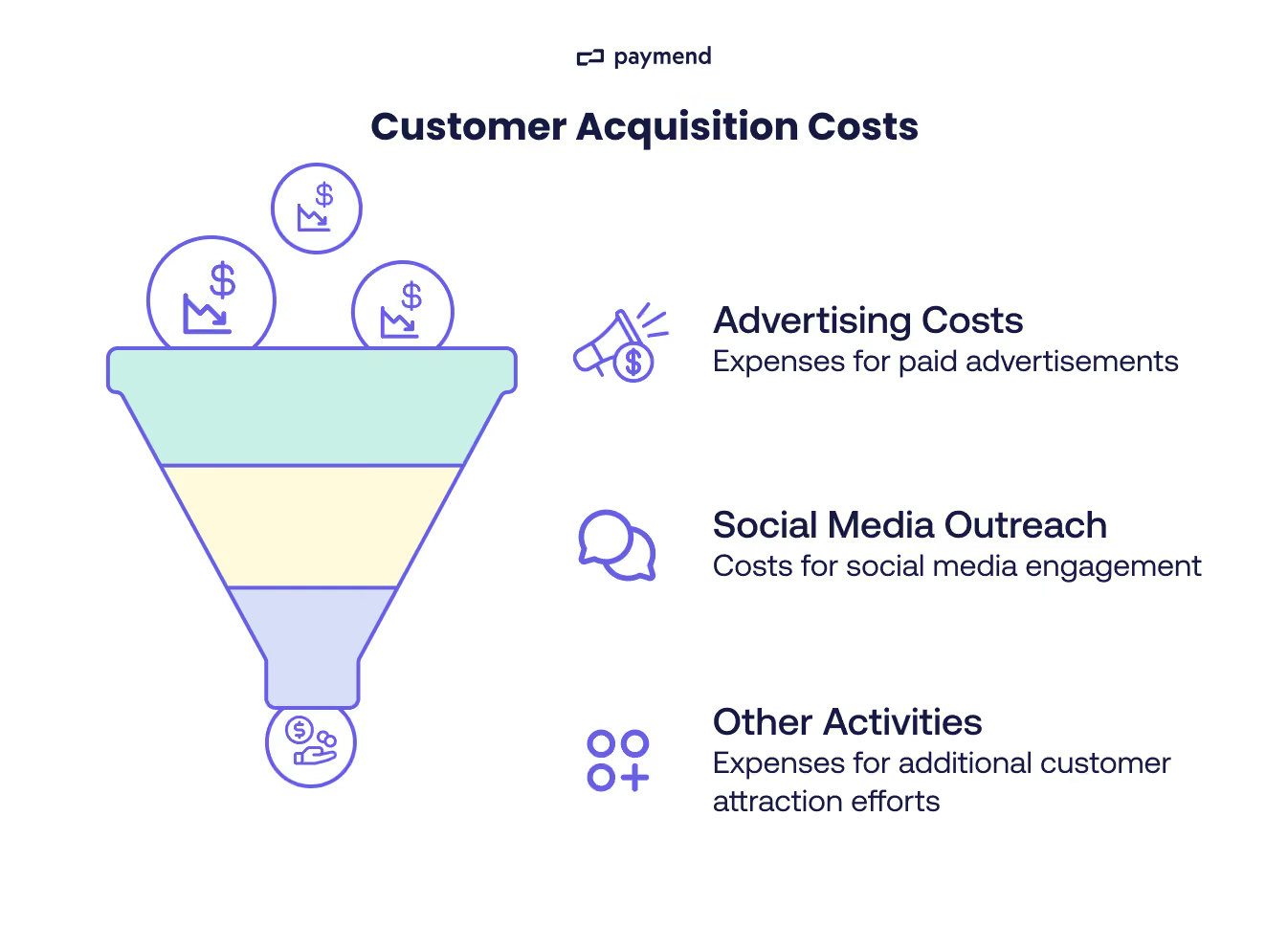
Customer acquisition cost is your best estimate of the cost to acquire a new customer. To calculate an accurate CAC, you need to factor in all costs associated with marketing, advertising, social media outreach, and other activities aimed at attracting new customers. By focusing on customers and across-the-board costs, CAC differs from Return on Ad Spend (ROAS), a related metric that compares advertising costs to the revenue they generate.
CAC ties in directly with your conversion rate optimization efforts. The more prospects you convert, the greater the impact of every dollar you’re spending on acquisition. Even after customers have demonstrated intent to buy, payment declines can derail sales and drive up CAC.
How to calculate customer acquisition cost
The basic formula for determining CAC is simple: it’s your total acquisition costs divided by the number of customers acquired.
The trick to CAC accuracy is to make sure you’re including everything that counts as “total acquisition costs,” meaning all your associated sales and marketing expenses, including all paid media, team salaries, and software tools. Resources that help you maximize CAC, such as payment recovery tools, also need to be factored in.
CAC is typically calculated over specific time periods. You need to ensure your time window includes both the spend and the customers it generates, as conversion can be a slow-moving process in certain industry sectors. Depending on your objectives, you can choose to collect and analyze data for blended CAC, which averages all your sales and marketing spending against all customer acquisitions. Or, look at channel-level CAC, which narrows your scope to specific marketing platforms.
You will also want to categorize new customers into cohorts based on when they were acquired. Keep all supporting info centralized in document management software for future reference and tweaks. This visibility will allow you to track the lifetime customer value (LTV) and differentiate between first-time and reactivated customers. A derived metric, “payback,” tells you how long it takes for a customer to “earn back” their acquisition costs.
Payment success: The CAC opportunity usually missed
Most CAC models effectively stop at ‘order submitted’ in the buyer journey. In reality, an order only becomes revenue after a chain of events:
Payment attempt → authorization decision → auth and capture → clearing/settlement.
If you’re measuring CAC against orders that never settle, your CAC looks artificially low because you’re counting customers you didn’t actually acquire. This gap is especially visible in card-not-present transactions, where issuers may decline legitimate transactions more often because they have less context and lean heavily on risk models. Many of these declines are good customers getting blocked.
Treating declines as a payment problem rather than a marketing problem lets you generate more revenue from the same cohort of customers and increase conversion rates without spending more. You’ll see faster CAC playback because fewer “would-have-been” customers fall out of the funnel at the point of payment authorization.
Harnessing a payment recovery engine is essential for turning paid demand into settled revenue by recovering legitimate card transactions.
For example, a solution like Paymend takes ownership of eligible declines and retries them on its own infrastructure. Integration is API-based and designed to operate behind the scenes, so there are no added customer steps.

9 ways to reduce customer acquisition costs
There are three pillars to an effective CAC reduction strategy, and we’ve got tips to help you implement each one of these practical customer acquisition strategies.
Pillar 1: Spend smarter and lower the cost of each qualified visit
1. Reallocate budget to your highest-LTV channels/campaigns
Let’s look at an example. Instagram and Facebook are both sending you customers. Facebook’s leads buy once and never come back. On the other hand, Instagram’s leads are sticking around and becoming loyal repeat buyers. In this scenario, you can adjust your ad spend accordingly because high-LTV customers can earn their payback many times over.
2. Refine your targeting to reduce wasted clicks
Research your market, talk to your customers, tighten up your audience segments, and create the kind of content that shows them exactly what your brand is and why they’re the ideal customer for it. Broadly appealing content can bring visitors to your site, but if you can’t close a sale once they’re there, you’re just serving up free entertainment.
3. Align ad messaging and landing pages to cut bounce
In today’s e-commerce environment, users are bombarded with ads they’d usually rather not see, and it can take a lot to get them to click on yours. When they do, the easiest way to immediately lose their attention is to present them with a landing page with no obvious connection to whatever motivated them to click your ad. Consistent messaging, visual and thematic harmony, and clear calls to action will keep them where they landed.
Pillar 2: Convert more of the traffic you already bought
4. Fix your top product-page blockers
Interested customers back away from purchases for predictable reasons. In retail, these are often issues like delivery times, return policies, and size or compatibility options. Most merchants will quickly get a sense of the top issues for their own customers (they’re often vocal about it), and taking proactive steps to address them can have an immediate impact on conversion rates.
5. Improve your merchandising
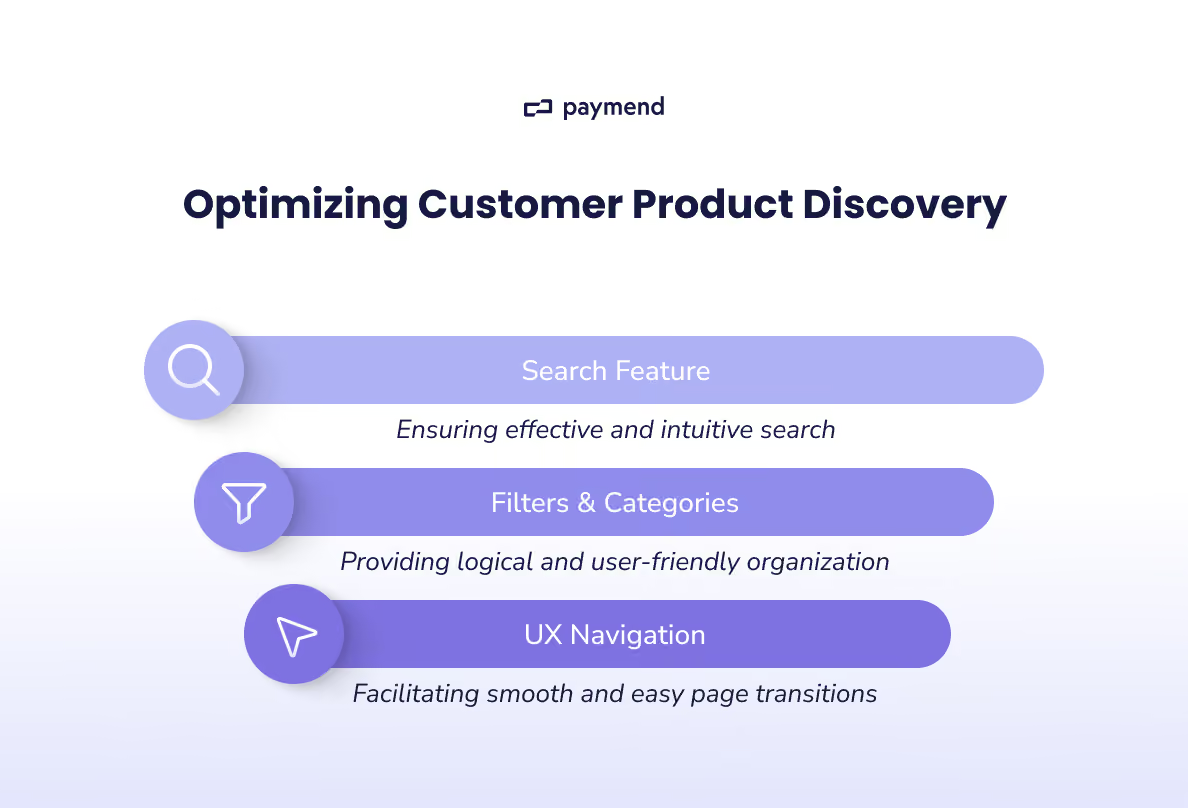
Once customers have found your site, can they find the products they came there to buy? Is your search feature robust and intuitive? Do your filters and product categories make sense? Does the UX facilitate smooth navigation to the correct pages? Wherever the answer isn’t an enthusiastic “yes,” you’re looking at a solvable issue that could be costing you sales and driving up your CAC.
6. Increase trust at decision points
Nearly every consumer has been burned by a disappointing online purchase at least once. At every point where your customer might stop to second-guess their decision, you want to give them a reason to continue onward to that “submit order” button. This means doing things like showcasing your best customer reviews (and thoughtfully addressing the negative ones), providing plenty of options for product delivery, and offering accessible customer support at every stage in the process.
Pillar 3: Stop losing acquired customers at payment authorization
7. Identify “false decline” cohorts and prioritize them
CAC fluctuates when you lose otherwise willing buyers to “false declines”. These are transactions where the customer intends to buy, and the issuer declines despite a legitimate transaction (often due to risk models or missing context). When customers from this cohort with an otherwise clean history come back, they’re demonstrating strong intent to buy, so don’t let payment issues get in their way a second time.
8. Treat issuer declines as conversion leakage, not “abandonment”
How you categorize your customers and follow up with them can make a huge difference in their ultimate conversion and LTV. Customers who are unable to complete a checkout due to issuer declines aren’t at all the same as customers who change their minds. Treating them differently is key to reducing cart abandonment (and stopping mislabeling declines as abandonment).
9. Recover declined card transactions behind the scenes
Not every lost checkout is “abandonment.” A meaningful share of would-be purchases fail at the last step because the issuer declines a legitimate card transaction. When that happens, you’ve already paid to acquire the customer, and then the revenue disappears at authorization.
Solutions like Paymend recover eligible declined card transactions behind the scenes, without adding customer steps or changing checkout. The result is more settled revenue per acquired cohort, faster CAC payback, and lower effective CAC without increasing fraud exposure.
Don’t let issuer declines inflate your CAC
The smartest way to lower CAC isn’t by adding to your customer count; it’s by turning the demand you paid for into settled revenue. No matter how strong you’ve made your sales funnel, it can still leak at the final moment when issuers decline good customers.
Every failed payment lowers your revenue per session, slows down payback, and inflates your CAC. To reduce it to its optimal level, you’ll need to get as much potential revenue as you can out of the clicks you’ve already invested in.
If issuer declines are a major source of conversion leakage, Paymend can help you recover revenue from declined card transactions without changing your checkout experience. Paymend retries on its own infrastructure and assumes fraud liability for recovered transactions, so you can improve realized conversion without taking on incremental risk. Merchants control what gets sent, Paymend can veto high-risk traffic, and you only pay on recovered revenue.
Book a demo to explore how Paymend leverages its own payment infrastructure and see the impact on CAC.
Paymend is committed to helping businesses make informed decisions about payments and revenue recovery. We strive to provide accurate, practical, and transparent content that meets the high standards we apply across our business.



.svg)