










How to reduce cart abandonment: A definitive guide

On this page
A customer fills their cart and clicks on “Checkout.” Then, just before the purchase is complete, they disappear into the void. Sometimes there’s no clear error, just a lost sale. For merchants, this moment is all too familiar. Cart abandonment is one of the most visible leaks in the e-commerce revenue funnel, but it’s also one of the most misunderstood.
Shockingly, the average global cart abandonment rate is 70%, showing how much revenue slips away. The good news is that cart abandonment is a measurable outcome that can be reduced by understanding where and why customers drop off. You simply need to look beyond surface-level optimizations to examine what actually happens at the final step of checkout.
Why? Not every abandoned cart is down to a customer’s change of heart. In many cases, reducing cart abandonment is a checkout performance and payments problem, especially when a card payment fails or gets falsely declined.
What is cart abandonment?
Cart abandonment occurs when a shopper adds one or more items to an online cart but leaves the site before completing the purchase. In practical terms, it happens after product discovery and selection, but before payment is successfully confirmed.
From a funnel perspective, this is late-stage drop-off. The customer has already evaluated the product, accepted the price, and taken an explicit step toward buying. That’s why cart abandonment is crucial for merchants to correctly understand and address, so they can recover revenue.
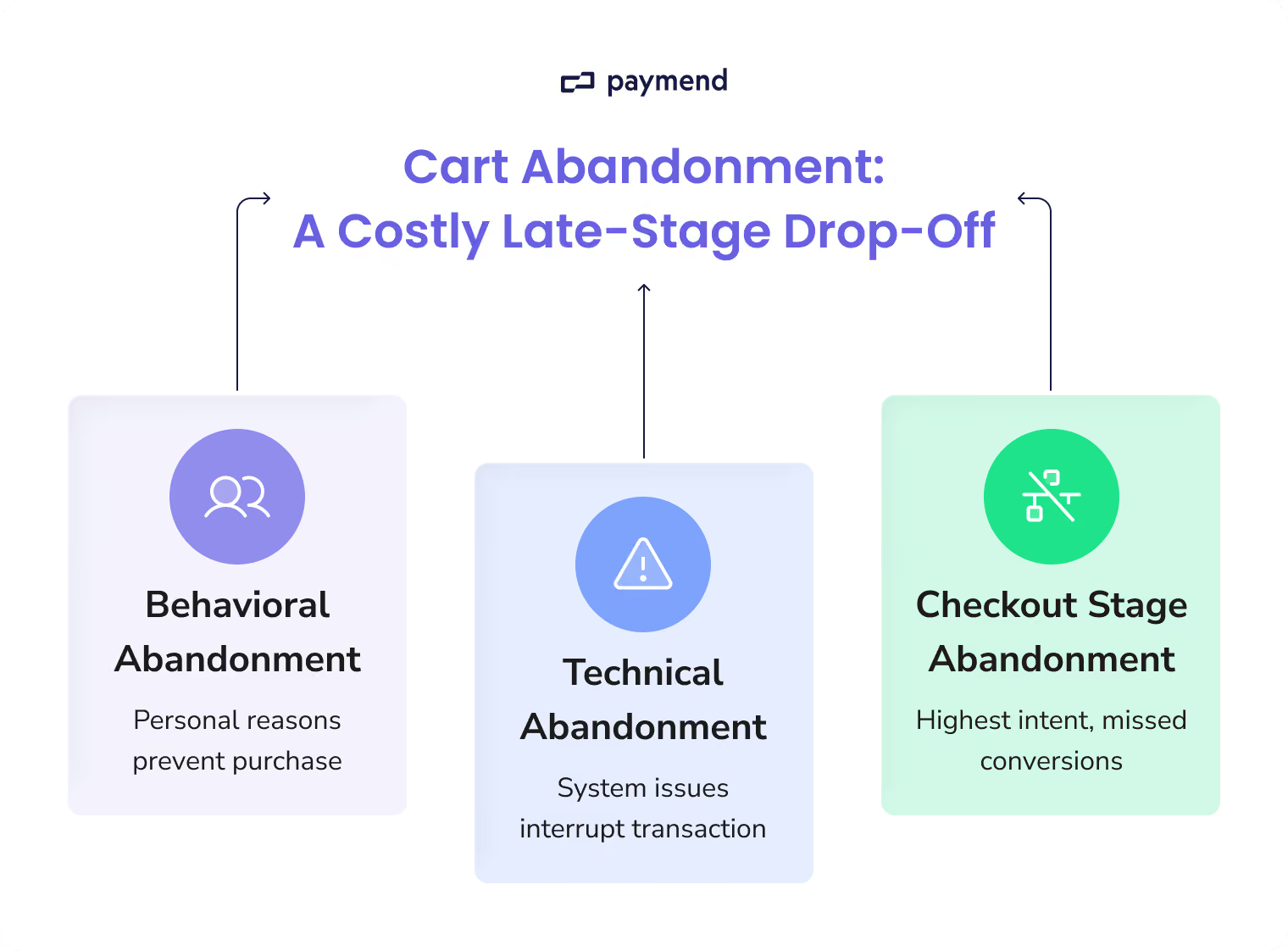
While cart abandonment is often discussed as a single metric, there are actually two different types:
Behavioral cart abandonment
Behavioral cart abandonment occurs when a shopper chooses not to complete a purchase for personal or situational reasons. These may include:
- Price monitoring and comparison
- Saving items for later
- Having second thoughts
- Simply being distracted.
In many cases, the intent to buy is tentative, and the shopper may return at a later time. This type of abandonment is a normal part of online shopping and is often addressed through a mix of pricing strategies, reminder campaigns, or follow-up messaging.
Checkout-stage abandonment
Checkout-stage cart abandonment happens when a customer intends to complete a purchase but is prevented from doing so by a system-level issue. Issues that can interrupt a transaction at the final step include:
- Checkout errors
- Slow page loads
- Confusing forms
- Payment failures
In these situations, intent remains high, but the purchase cannot move forward. Unlike behavioral abandonment, merchants can reduce this type of cart abandonment by improving checkout performance and addressing technical issues within the payment flow they control.
Why checkout-stage abandonment matters most
Abandonment at checkout is especially costly because it happens where purchase intent is highest. By the time a customer reaches payment, most of the work required to earn the sale has already happened. When transactions fail at this stage, merchants miss conversions that were already within their reach. That’s why focusing on checkout-stage abandonment, particularly the technical causes, can meaningfully affect revenue.
How to calculate your cart abandonment rate
Calculating your cart abandonment rate starts with two core metrics:
- Carts created: A cart is typically counted as ‘created’ when a shopper adds at least one item to their cart and reaches the cart or checkout page.
- Completed purchases: A purchase is recorded when the shopper successfully completes checkout and payment is confirmed.
The exact definitions can vary slightly by platform, but these two numbers form the foundation of any calculation of cart abandonment.
The standard formula for cart abandonment rate is straightforward:
(Carts created – Completed purchases) ÷ Carts created
Here’s an example: If 1,000 carts are created in a given period and 300 result in completed purchases, 700 carts are abandoned, so your cart abandonment rate would be 70%. This calculation helps quantify how much late-stage demand is failing to convert, which is why it is widely used across e-commerce teams.
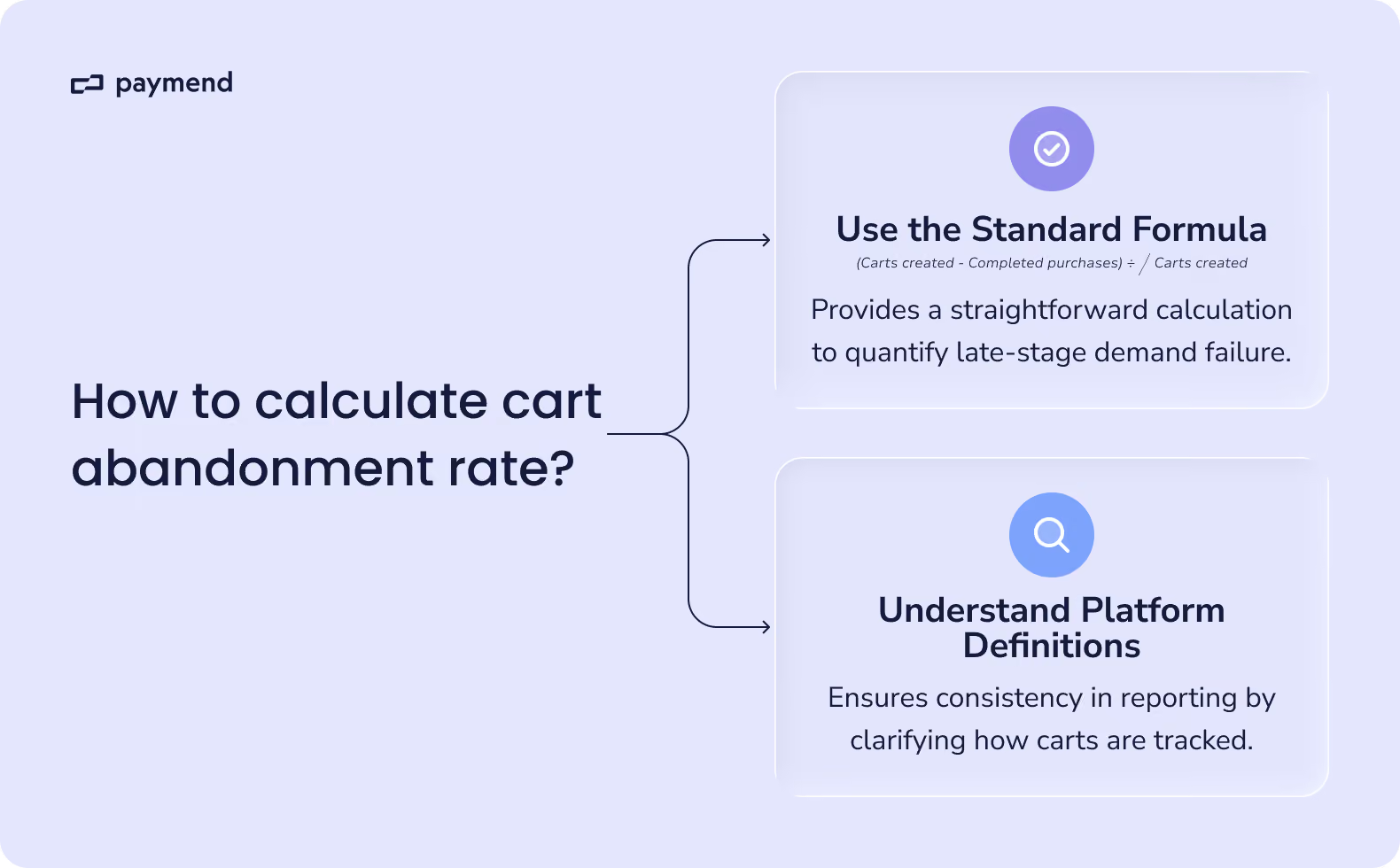
It’s essential to understand how your analytics tools define and track carts created and completed purchases. Platforms such as Shopify, GA4, and custom payment stacks don’t all measure the same moments in the same way. Depending on the setup, a “cart” may be counted early in the journey or only once a shopper reaches checkout. That’s why consistency within your own reporting matters more than comparing abandonment rates across tools.
Finally, while cart abandonment rate is a useful diagnostic metric, it does not explain why customers abandon on its own. Many factors, like pricing friction or technical checkout issues, can drive a high rate. To effectively reduce cart abandonment, merchants need to pair this metric with a deeper analysis of where drop-off occurs and what happens at the moment a purchase fails to complete.
How does reducing cart abandonment impact revenue?
Higher checkout conversion rates
When fewer customers drop off at checkout, a greater share of sessions convert into completed purchases. Even modest improvements in checkout conversion can affect revenue because they apply to traffic that has already cleared earlier decision points.
Immediate, measurable revenue lift
Recovered carts translate directly into additional sales. Unlike brand awareness or demand generation efforts that take time to influence results, reducing cart abandonment produces a near-term impact. Revenue gains are visible in metrics such as completed orders, average order value, and overall transaction volume.
More efficient growth without more spend
Improving conversion efficiency is often faster and more cost-effective than acquiring new traffic. Instead of increasing ad budgets or expanding channels, merchants can generate more revenue from existing demand, which becomes especially important as customer acquisition costs rise.

Stronger returns than top-of-funnel optimization
Checkout-stage improvements tend to outperform top-of-funnel changes because they affect customers who are closest to purchase. While optimizing product pages or landing pages can help, resolving friction at the final step is what really determines whether revenue is captured or lost.
Better signal for payment and funnel performance
A lower cart abandonment rate can also serve as a valuable signal of healthier checkout and payment performance. When abandonment declines, it often reflects fewer technical failures and more reliable transaction flows, which support steadier revenue and more predictable forecasting.
How payment failures contribute to cart abandonment
A payment failure occurs when a transaction cannot be authorized or completed successfully, even though the customer has provided their payment details and intends to buy. Some failures are recoverable (false declines, soft declines); others require updated credentials or different payment details.
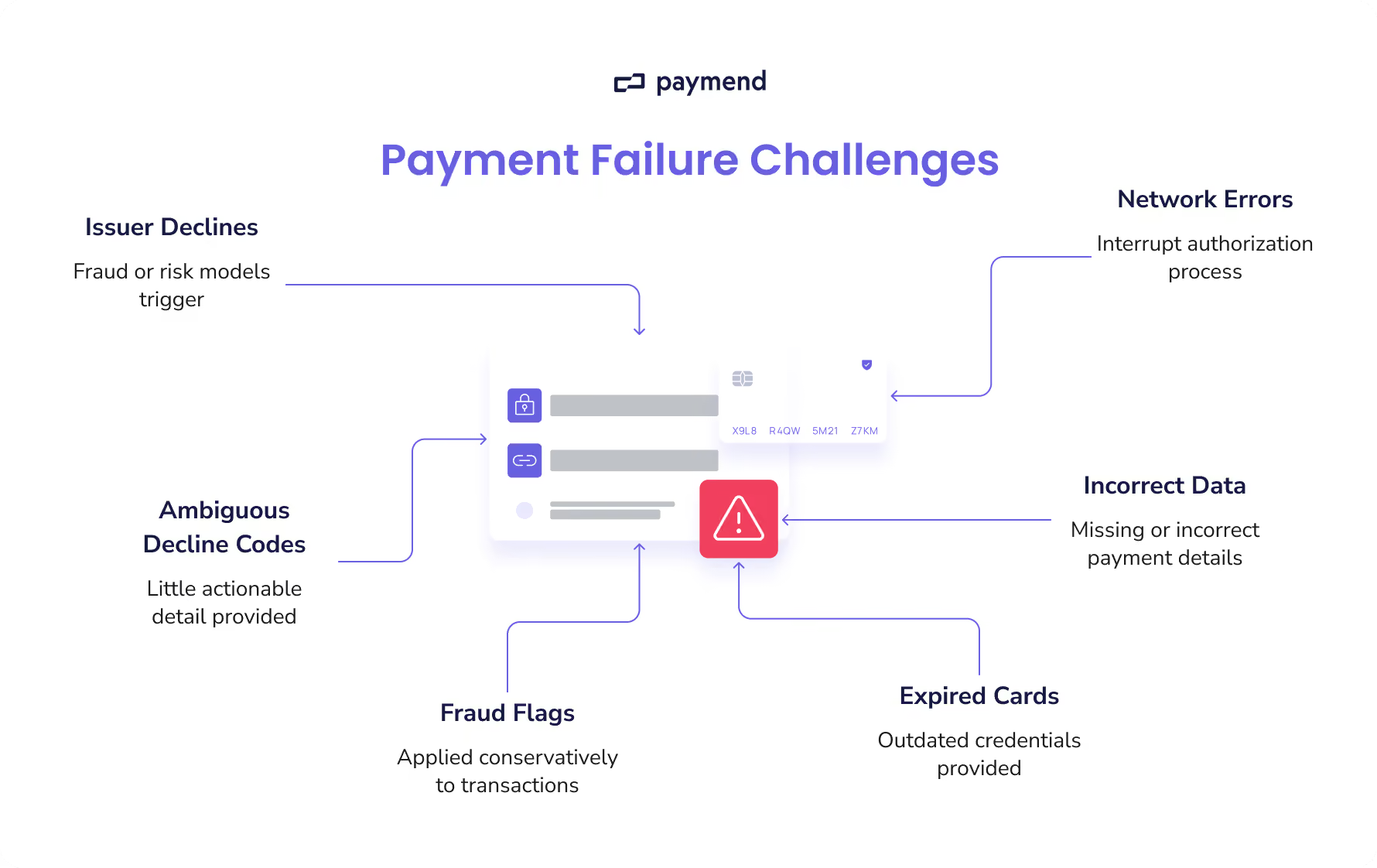
Common causes of payment failure include:
- Issuer declines triggered by fraud or risk models
- Generic decline codes, such as “do not honor,” which provide little actionable detail
- Suspected fraud flags applied conservatively to card-not-present transactions
- Expired cards or outdated credentials
- Incorrect or missing payment data
- Network or gateway errors that interrupt authorization
Many common decline responses are intentionally non-specific (for security and policy reasons) or are mapped into generic codes by processors.
Unfortunately, payment failure is one of the most overlooked contributors to cart abandonment because it is often misclassified as customer drop-off. When a cart is abandoned, it’s easy to assume the shopper chose not to complete the purchase. But failed payments are different. In these cases, the customer is actively trying to pay, but their transaction is rejected somewhere in the payment flow. In high-level funnel reporting (carts created vs purchases), both can look like abandonment unless you separately track failed payment attempts and the reasons for declines.
Why online payments are more likely to be declined
Online, card-not-present transactions are more likely to be declined than in-store payments because issuers have less contextual information (for example, physical card or chip-based verification) to work with at the moment of authorization.
As a result, issuer risk models rely more heavily on signals like device data, transaction patterns, merchant history, and transaction velocity. If those signals are incomplete or raise caution flags, declined transaction rates increase, particularly for higher-value purchases or during traffic spikes.
The customer experience impact of payment failures
For customers, a failed payment is confusing and frustrating. Error messages are often vague, offering little guidance on what went wrong or how to fix it. After one or two failed attempts, trust can erode quickly. Customers may abandon the purchase entirely or question whether the merchant can process payments reliably.
In these moments, cart abandonment is not driven by hesitation or price sensitivity. It’s the direct result of a payment breakdown at the point where purchase intent is highest.
7 proven strategies for reducing cart abandonment
1. Simplify the checkout experience
A complex checkout experience increases the likelihood that customers abandon their shopping cart before they complete a purchase. Each unnecessary step or moment of confusion creates friction at a stage where the shopper's momentum should be uninterrupted, especially for mobile users and repeat buyers.
How to do it:
- Reduce the total number of steps required to complete checkout.
- Limit form fields to just the information required for fulfillment and payment.
- Offer "guest checkout" as a default option rather than forcing them to create an account.
- Use "address autocomplete" and inline validation to prevent avoidable errors.
- Test and optimize checkout performance on mobile devices.
2. Be transparent about costs early
Unexpected costs introduced late in checkout are a common reason shoppers abandon carts, even after they have committed to the purchase. Cost transparency builds trust and allows customers to make an informed decision before reaching the payment step.
How to do it:
- Show shipping costs and taxes before checkout begins.
- Offer shipping estimators directly in the cart.
- Make return and refund policies easy to find and understand.
- Avoid adding any surprise handling fees or surcharges in the last steps.
3. Build trust at checkout
Checkout is the point where customers decide whether they trust a merchant enough to share payment details. If your store is showing weak or unclear trust signals, customers may hesitate even when product and pricing decisions are already made.
How to do it:
- Display familiar card network and payment method logos.
- Place refund and return policies close to the payment form.
- Maintain consistent store branding throughout the checkout flow.
- Avoid redirecting your customers to any unfamiliar domains without explanation.

4. Offer the right payment methods
Customers cannot complete a purchase if their preferred payment method isn't available. Payment preferences vary across geography, devices, and customer segments, among other factors, which makes payment method flexibility critical to conversion.
How to do it:
- Review transaction and abandonment data by region and device type.
- Support the card networks and local payment methods your customers actually use.
- Ensure mobile wallets are fully supported where relevant.
- Regularly reassess your accepted mix of payment methods.
5. Follow up on behavioral abandonment
Some shoppers leave the checkout stage simply because they get interrupted or are not ready to complete the purchase at that moment. Follow-up helps by giving them a clear, low-effort path to return and finish the transaction later, without having to repeat the entire buying process.
How to do it:
- Integrate email tools or marketing automation to send cart recovery emails shortly after a cart is abandoned.
- Preserve the customer's cart contents so they can easily resume checkout at a later time.
- Focus follow-up emails to provide clarity and reassurance to the customer before you offer them a discount.
- Use incentives selectively rather than defaulting to price reductions.
6. Optimize checkout performance and reliability
Technical instabilities at checkout can cause cart abandonment even when your customer's intent to purchase is high. Experiencing issues at checkout, like slow load times or validation failures, interrupts the purchase at the worst possible moment.
How to do it:
- Track checkout latency and frontend error rates continuously.
- Monitor payment failures along with performance metrics.
- To catch potential failures before customers do, test checkout flows under a range of real-world conditions.
- Treat checkout reliability as an ongoing operational responsibility.
7. Address failed payments and false declines
Not all payment failures are caused by insufficient funds or customer error. In many cases, legitimate card transactions are declined by issuer risk models, especially in card-not-present situations. When that happens, the customer hasn’t changed their mind. They’re trying to buy, but the payment doesn’t go through.
Traditional checkout optimization tends to fall short once a payment has already been declined. Paymend is built specifically to convert these declined card transactions into settled revenue without changing checkout UX or asking the customer to retry. Paymend takes ownership of eligible declined transactions, retries them on Paymend’s own infrastructure, and manages risks. Merchants keep control over what gets sent, and Paymend can reject traffic that doesn’t meet risk thresholds.
How to do it:
- Distinguish between abandonment driven by user behavior and abandonment caused by payment failures.
- Review decline codes to identify transactions that may be recoverable.
- Use a payment recovery solution like Paymend to recover falsely declined card transactions without changing the checkout experience.
- Track approval rate improvements and recovered revenue as primary success metrics.
Addressing failed payments and false declines helps reduce cart abandonment by improving approval rates and capturing revenue that standard UX or messaging optimizations leave behind.
How to recover revenue lost to failed payments
Cart abandonment becomes most actionable at the checkout stage, where intent is clear, and outcomes are immediately measurable. For merchants, this makes checkout-stage optimization one of the most efficient ways to reduce cart abandonment and drive growth, especially compared to efforts that rely on attracting additional traffic.
Many cart abandonment strategies focus on optimizing the checkout experience rather than what happens when a payment attempt fails. False declines remain a hidden but highly impactful driver of abandonment, particularly in card-not-present transactions. Paymend closes that gap by taking ownership of declined card payments and retrying them on Paymend’s own banking infrastructure while assuming liability. Merchants choose what to send, Paymend can reject high-risk traffic, and there’s no checkout disruption or customer action required.
Book a Paymend demo today to see how much revenue you can recover from false declines and failed card payments with no changes to checkout.
Paymend is committed to helping businesses make informed decisions about payments and revenue recovery. We strive to provide accurate, practical, and transparent content that meets the high standards we apply across our business.





.svg)